
Weather Series: Part 1
What is Risk Management?
Imagine you're set to take off, but looming thunderstorms along your flight path give you pause. Welcome to the critical arena of aviation risk management. Contrary to common misconceptions, risk management isn't about eliminating all risks—a feat that would be impossible.
Instead, risk management is about making informed decisions. It focuses on identifying hazards, like unpredictable weather, and reducing their associated risks to an acceptable level. As defined in the Pilot's Handbook of Aeronautical Knowledge (PHAK), the objective is to "proactively identify safety-related hazards and mitigate the associated risks."
In this guide, we'll unpack a six-step process to "integrate risk management into planning at all levels", aiming to effectively mitigate weather-related risks. Whether you're a novice or an experienced pilot, our goal is to equip you with the decision-making tools to ensure the safest possible flight.
6 Steps: How to Mitigate Weather Risk
Navigating the uncertainties of weather conditions requires a structured approach. In this section, we break down a step-by-step methodology based on the Pilot's Handbook of Aeronautical Knowledge (PHAK) for managing weather-related risks.
- Identify Hazards:
The initial step involves recognizing potential weather threats that could impact your flight. Ask yourself, are there thunderstorms, fog, or strong crosswinds in the forecast? - Assess Risks:
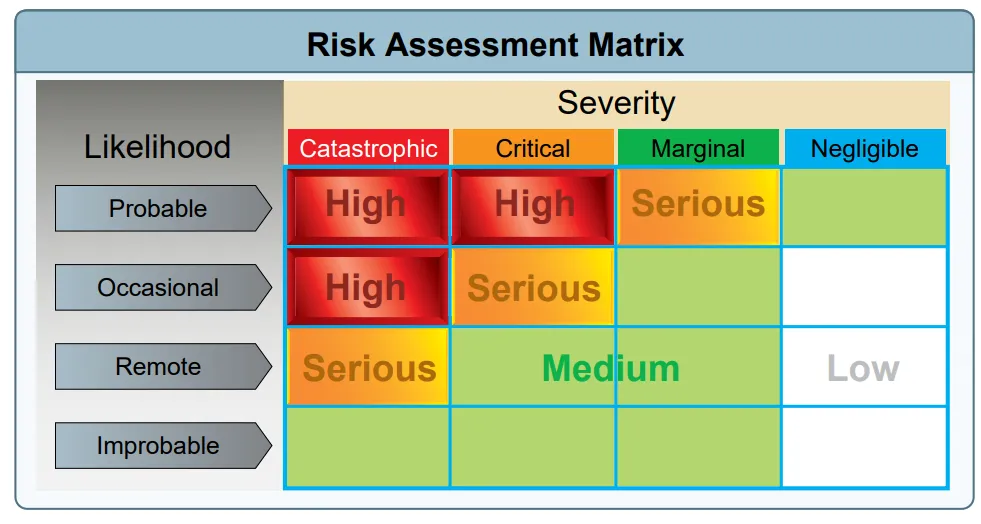
Once you've identified the hazards, it's time to quantify the risks involved. Will you likely run into a thunderstorm? If so, what could be the level of severity? Refer to the risk assessment matrix above. - Analyze Controls:
After assessing the risks, explore the various mitigation measures at your disposal. These could range from rerouting, selecting a new destination, choosing a different altitude, postponing the flight, or even having a flight instructor experienced in those specific conditions accompany you. - Make Control Decisions:
This phase is crucial; it's where you determine your course of action. Select which methods from your analysis will reduce the risk to an acceptable level. This is where you finalize your risk mitigation strategies. - Use Controls:
Once your decisions are made, it's important to stick to your plan. Keep in mind that weather can be unpredictable; thus, be willing to adapt your initial controls as you go. Be prepared for any necessary changes, like diverting, delaying, or even canceling the flight. - Monitor Results:
Throughout and following the flight, continually evaluate the effectiveness of your risk management steps. This retrospective analysis allows you to refine your approach for future endeavors.
By following these six steps, you can mitigate weather-related risks to an acceptable level, setting the stage for a safer journey through the skies.
Aviation Weather Accidents
In the realm of general aviation, weather-related accidents constitute a small yet significant fraction of overall incidents. According to the 32nd Joseph T. Nall Report, a staggering 74% of weather-related accidents in 2020 resulted in fatalities.
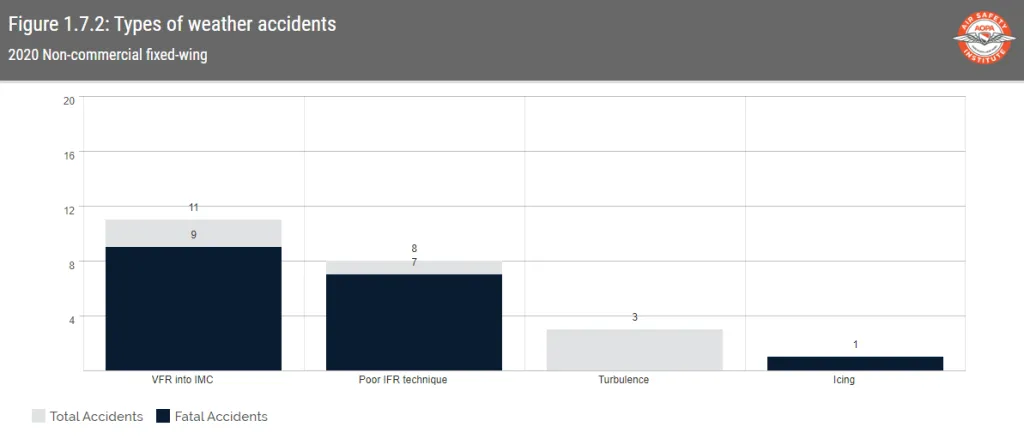
The majority of these accidents were caused by VFR into IMC conditions or poor IFR technique. Here at Pilot Rise Flight School, we emphasize training in various weather conditions to build both experience and confidence.
Key strategies for mitigating weather risks include training in Instrument Meteorological Conditions (IMC), practicing approaches in both real-life and simulators, and remaining proficient and current. This comprehensive approach to training not only improves skills but also cultivates a mindset that prioritizes safety, reducing the risk of weather-related accidents throughout one's aviation career.
Examples of Mitigating Risk
Here are two real-world scenarios to clarify the principles of risk mitigations regarding weather.
Cross-Country Thunderstorm
Suppose you're set to fly a 150-nautical-mile training cross-country with forecasted enroute thunderstorms. The initial risk assessment could classify this flight as "High" risk due to probable storms and critical outcomes. However, rather than just canceling the flight, consider risk controls. You might be able to reroute to dodge the storms, adjust departure time, or select a different destination. If these controls reduce the likelihood of encountering a storm to "remote" while keeping severity at "critical," your risk level shifts to "Medium," which might be acceptable.

Strong Crosswinds
You’re comfortable with a 10-knot crosswind, but today it’s 20 knots. Instead of canceling the flight or taking undue risk, you can mitigate this risk. For instance, you can fly with a certified flight instructor (CFI) who has experience in these conditions. The risk may initially appear "High," but a proficient instructor could lower that risk level to "Medium" by rendering the likelihood of an accident "improbable."
In both examples, the aim isn't to eliminate all risks but to bring them to an acceptable level through thoughtful strategies. Whether it’s weather, mechanical issues, or personal limitations, proper risk assessment and mitigation help ensure that flights are as safe as they can be. These processes form the cornerstone of responsible and professional aeronautical decision-making.
Avoiding Hazardous Attitudes
It's crucial to be aware of hazardous attitudes that can impede effective risk management.
Two hazardous attitudes, "Invulnerability" and "Macho," can impair risk management, especially in weather-related decisions. "Invulnerability" leads to overconfidence, making pilots think, "It won't happen to me." Counter this with the reality check: "It could happen to me." The "Macho" attitude pushes pilots into unnecessary risks, fueled by the thought, "I can do it." The antidote is: "Taking chances is foolish."
As experience grows, so does the potential for these attitudes to develop. One way to keep them in check is through peer discussions about your flight plans and experiences. By actively countering these attitudes, you contribute to safer skies and more responsible aviation.
Mitigating Risk Like a Professional
In the airline industry, and at our flight school, risk management transcends simple go/no-go decisions. Using a Threat and Error Management (TEM) framework, airlines operate with the mindset of "we are going, now find out how to get there safely." At our flight school, we instill this professional ethos, focusing not on the impossible task of eliminating risk, but on mitigating it to acceptable levels.
Our training goes beyond FAA requirements to prepare students for real-world scenarios. We emphasize dynamic decision-making and situational awareness, providing exercises that mimic actual risks, thereby equipping our students with essential risk management skills.
The objective is to cultivate not just technically proficient pilots but also competent decision-makers. By teaching our students to recognize hazards and manage them effectively, we aim to contribute to a safer and more efficient aviation ecosystem.
Ready to fly? Join us on a Discovery Flight.